Last spring, a café owner in Manchester told us her website “looked fine.” It loaded slowly, the menu was a PDF you had to pinch and zoom, and the booking form quietly failed on iPhones. She had no idea. Her customers just stopped booking, and she assumed the phone was going quiet because of the weather.
Stories like this are why buying a website is so hard. From the outside, a site either looks good or it doesn’t. The real difference between a site that earns money and one that merely exists sits underneath, in the code, the structure, the hosting and the thinking behind it. Let’s pull back the curtain on what quality website development services actually involve, so you can judge any agency’s quote with confidence.
Why Website Development Services in UK Look Different Now
A decade ago, “having a website” was the achievement. Today it’s the starting line. UK buyers compare three or four businesses in a single sitting, usually on a phone, often on a train or a sofa. Your site has to earn trust before they ever speak to you.
Customers Judge in Seconds
Visitors form an opinion almost instantly, and it’s based on speed, clarity and whether the page works on their device. Clunky navigation, tiny tap targets and walls of text all send people back to the search results. A well-built site makes the next step obvious: call, book, buy or enquire.
Search Engines Reward Well-Built Sites
Google’s own search engine optimisation starter guide makes it clear that clean structure, helpful content and a good page experience matter. None of that can be bolted on cheaply afterwards. It has to be part of the build from day one, which is why development and search engine optimisation should be planned together rather than bought separately.
What Professional Website Development Services in UK Include
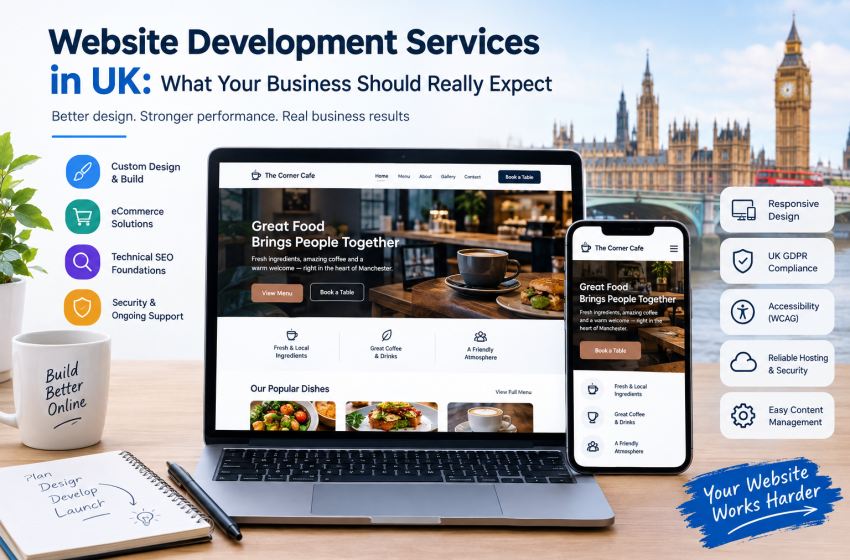
Quotes vary wildly because agencies bundle different things. Here’s a plain-English breakdown of what a thorough service covers.
Custom Design and Build
A proper build starts with your customers, not with a template. That means mapping what visitors need, sketching page layouts, then developing something that reflects your brand.
Bespoke Versus Template: Which Suits You?
Templates are quick and cheap, but they come with baggage: bloated code, generic layouts and limited room to grow. A bespoke build costs more upfront but usually pays back through faster load times, easier updates and a site that looks like you. For most growing businesses, a hybrid works best: a robust framework with custom design layered on top.
Content Management You Can Actually Use
You shouldn’t need a developer to change a phone number. Our WordPress development work focuses on editing screens that make sense to non-technical teams, so you can update pages, publish news and add offers in minutes.
eCommerce That Sells, Not Just Displays
Online shops have extra moving parts: product catalogues, payments, stock, shipping rules and checkout flow. Getting these wrong costs sales quietly. Our eCommerce development team builds stores around a simple principle: fewer clicks between “I want that” and “order confirmed.”
Shopify for Speed to Market
If you want to launch quickly with reliable hosting and built-in payments, Shopify development is often the sensible route, especially for product-led brands.
WooCommerce for Flexibility
If you already run WordPress or need deep customisation, WooCommerce web development gives you far more control over how the store behaves and looks.
Technical SEO Foundations
Good development bakes in tidy URLs, sensible headings, image optimisation, schema markup and fast performance. It’s far cheaper to build these in than to retrofit them later.
Hosting, Security and Ongoing Care
A site isn’t finished at launch. Plugins age, browsers change and security threats evolve. Reliable hosting and domain services paired with regular website maintenance keep your site fast, backed up and protected without you having to think about it.
Where Responsive Website Design London Fits In
If your customers are in the capital, expectations are higher still. Londoners browse on the move, switch between devices constantly and have little patience for slow pages. Responsive website design London businesses depend on means layouts that adapt smoothly from a phone in the Tube to a desktop in Canary Wharf, with the same content, the same speed and the same clear calls to action.
Responsive isn’t a feature you add at the end. It’s a way of designing every component so it flexes naturally. If an agency treats it as an optional extra, treat that as a warning sign.
Compliance and Accessibility Most Agencies Skip
Professional website development services in UK should quietly handle the legal and ethical basics, so they never become your problem.
UK GDPR and Cookie Consent
If you collect enquiries, run analytics or place cookies, you’re handling personal data. The ICO’s guidance on UK GDPR explains your responsibilities. A competent agency builds compliant forms, consent banners and privacy pages as standard.
Accessibility for Everyone
An accessible site works for people using screen readers, keyboards or magnification, and it tends to be a better site for everyone. The WCAG guidelines are the recognised benchmark. Ask any agency how they test against them.
Signs Your Website Is Ready to Convert
Use this quick health check on your current site:
- It loads in a couple of seconds on mobile data.
- Your main call to action is visible without scrolling.
- Forms work on every device you’ve tested.
- Each key service has its own page with clear, useful copy.
- You can edit content yourself.
- You know how many enquiries it generated last month.
If you ticked fewer than four, a rebuild or redesign will likely pay for itself. If you’re moving from an older platform, our website migration services protect your rankings and content during the switch.
See WhatGood Looks Like
Nothing beats seeing real work. Browse our case studies to see how we’ve approached different sectors, from the retail build in Home Decor UK to the sector-focused Construction Agencies project. If you work in the trades, our page on web design for construction companies explains what we do differently for your audience.
So, Is Your Website Working as Hard as You Are?
Think back to the café owner. Nothing was wrong with her food or her service. Her website simply wasn’t doing its job, and nobody had told her.
Take five minutes to open your own site on your phone and try to book, buy or enquire as a stranger would. What did you notice? If the answer makes you wince, we’d love to help. Have a look at our pricing plan, then get in touch for a free consultation. We reply within one working day. And tell us in the comments: what’s the one thing that frustrates you most about your current website?
FAQs
- What do website development services in UK typically include?
Most include planning, design, front-end and back-end development, content management setup, mobile responsiveness, basic SEO foundations, testing and launch. Many agencies also offer hosting, maintenance and eCommerce. - How long does a business website take to build?
A standard business website often takes a few weeks. Larger eCommerce or custom projects need longer, depending on the number of pages, features and how quickly content and feedback arrive. - Is responsive website design London-specific?
No, responsive design works everywhere, but London audiences are especially mobile-heavy and competitive, so speed and mobile usability matter even more for businesses targeting the capital. - Can you rebuild my existing website without losing my Google rankings?
Yes. With proper redirects, content mapping and technical checks during migration, rankings can be protected and often improved. - How much do website development services in UK cost?
Cost depends on design complexity, page count, functionality and integrations. A tailored quote based on your requirements is the most accurate way to budget.