Seventy-two Google results, four identical “top 10 web design agencies” listicles, and a dozen homepages that all promise to be “award-winning” — that is usually what greets anyone who searches for a local web partner. Somewhere in that noise is an agency capable of genuinely transforming your business, and somewhere else is an agency that will hand you a slightly-modified template and vanish after invoicing you. Telling the two apart from a search results page alone is nearly impossible, which is exactly the problem this guide is here to solve.
Why “Near Me” Matters More Than People Assume
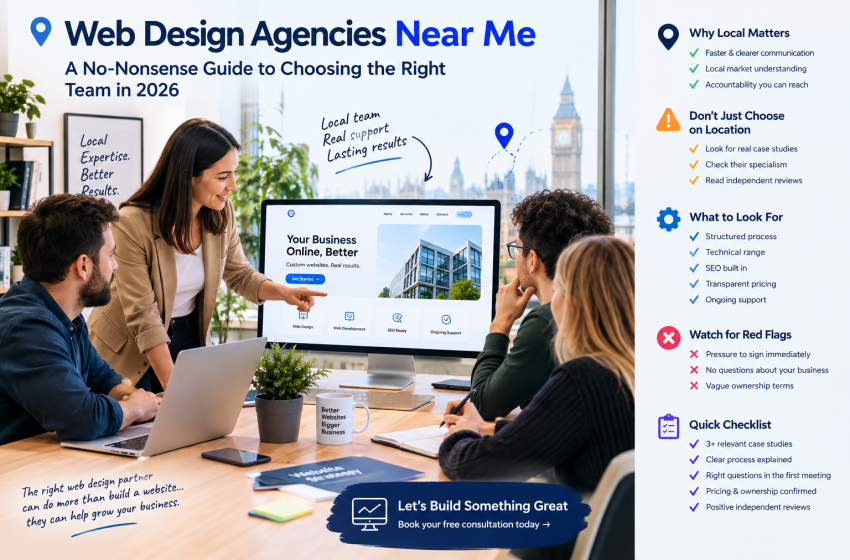
There is a reason local search intent has grown steadily every year — proximity still shapes trust, and business decisions are no exception.
Faster, Clearer Communication
Time zones stay aligned, working hours overlap fully, and video calls can become in-person meetings when a project needs deeper discussion. For anything involving brand nuance — tone of voice, visual identity, the personality of your business — that kind of direct communication tends to produce sharper results than messages passed back and forth across a delay.
Local Market Understanding
A UK-based custom web agency UK understands UK consumer habits, seasonal buying patterns, GDPR obligations and local competitor landscapes in a way an overseas team may only understand in theory. That context quietly shapes dozens of small decisions throughout a project.
Accountability You Can Actually Reach
If something breaks post-launch, a local agency is easier to hold accountable — you are not waiting on a support ticket routed through multiple time zones. This matters most in the weeks immediately after launch, when small issues are common and speed of response really counts.
The Trap of Choosing on Location Alone
Here is the part most guides skip: “near me” narrows the list, but it should never be the deciding factor by itself.
Portfolio Depth Beats Proximity
A local agency with three thin case studies is a bigger risk than a slightly-further-away agency with a decade of documented results. Before shortlisting anyone, look for real case studies that show measurable before-and-after outcomes, not just polished screenshots.
Specialism Sometimes Outweighs Distance
If your business needs a complex eCommerce build with product variants, stock syncing and payment gateways, an agency twenty minutes away with zero eCommerce experience is a weaker choice than a slightly further agency that builds online stores every week.
Reviews Tell You What Sales Pages Won’t
Sales copy is written to persuade. Third-party reviews on Google, Trustpilot or Clutch tend to reveal the details that matter most — how deadlines were handled, how disagreements were resolved, whether support actually showed up after the invoice was paid.
What a Strong Custom Web Agency UK Should Offer
Once you have a shortlist, the real evaluation begins. Here is what separates the agencies worth hiring from the ones worth avoiding.
A Documented, Repeatable Process
Discovery Before Design
Ask what happens in week one. If the answer jumps straight to “we’ll send you some template options,” that is a warning sign. Strong agencies start with structured discovery — your goals, your audience, your competitors — before any design work begins.
Design Reviews Built Into the Timeline
You should know in advance how many rounds of feedback are included, and at what stages you will see progress. Vague timelines usually lead to scope disputes later.
Technical Range Beyond WordPress Basics
The best agencies are comfortable across multiple platforms and use-cases — WordPress development, Shopify builds, and custom-coded solutions — and recommend the right one for your business rather than defaulting to whatever they know best.
SEO Foundations Baked In, Not Bolted On
Search visibility should influence site structure, page speed and content hierarchy from day one. A site that looks great but was never built with search engines in mind is a common and expensive mistake; organisations like Think with Google have published benchmark research showing just how much page speed alone affects visitor behaviour, which is a strong argument for treating technical performance as core design work, not an afterthought.
A Note on Page Speed Benchmarks
Research on mobile load times has repeatedly shown that bounce probability rises sharply as pages get slower to load — every additional second matters more than most businesses assume, which is exactly why technical foundations belong inside the design process rather than outside it.
Transparent Pricing and Ongoing Support
A trustworthy agency explains costs clearly upfront, including what happens after launch. Look closely at their pricing plan and ask directly what is and is not included, so there are no surprises three months in.
Red Flags to Watch For During the Sales Process
Pressure to Sign Immediately
Genuine agencies are comfortable with you comparing options. Pressure tactics — “this price expires today” — are far more common among agencies that know their process cannot survive scrutiny.
No Questions About Your Business
If an agency can quote you a price within the first five minutes without asking what your business actually does, that quote was not built around your needs — it was built around a standard package.
Vague Answers About Ownership
Always confirm, in writing, that you will own the final website, its code and its content outright. Some agencies quietly retain control through proprietary platforms that lock you in.
A Simple Checklist Before You Sign
- Have you seen at least three relevant case studies with real, measurable outcomes?
- Does the agency explain their process clearly, step by step, without vague language?
- Do they ask more questions than they answer in the first meeting?
- Is pricing, ownership and post-launch support confirmed in writing?
- Do independent reviews match the story the agency tells about itself?
If you can answer “yes” to all five, you have very likely found a genuine partner rather than a vendor.
Let’s Talk About Your Project
Searching for “web design agencies near me” is the easy part — choosing the right one is where most businesses either win years of stronger performance or spend the next year fixing avoidable mistakes. If you want a team that starts with questions instead of quotes, book your free consultation today and let’s talk through exactly what your business needs before anything gets designed.
Frequently Asked Questions
- Should I only consider web design agencies near me? Location is a helpful starting filter for communication and accountability, but portfolio quality, industry experience and post-launch support should carry more weight than proximity alone when making a final decision.
- What questions should I ask before hiring a custom web agency UK? Ask about their discovery process, typical project timelines, what is included in ongoing support, who owns the final website and code, and whether they can show measurable results from similar past projects.
- How do I know if an agency’s case studies are genuine? Look for specific, measurable outcomes tied to named clients and industries, rather than vague claims. Genuine agencies are usually happy to explain the strategy behind a result, not just show a finished screenshot.
- Is it a red flag if an agency offers a very low quote? Not always, but unusually low quotes often mean limited discovery, template-based design, or reduced post-launch support, so it is worth asking exactly what is and is not included before assuming it is a bargain.
- What should be included in ongoing web design support? Reliable ongoing support typically covers security updates, backups, performance monitoring, minor content changes and technical troubleshooting, so your website stays secure and functional well beyond the initial launch.