Think about the last page you gave up on. Not the one with the wrong answer, but the slow one: the spinning wheel, the layout that lurched downwards just as you went to tap, the pop-up that arrived before you had read a single word. You did not complain. You simply left. Now flip it around. Somewhere, right now, a visitor is doing exactly that to a website, and all the data that travelled for nothing burned a little electricity on its way there and back.
Written for business owners, marketers and managers who have searched for a “sustainable web design agency UK” or for “local web designers near me” and want something practical instead of preachy. We will bust four common myths, lay out a thirty-day roadmap you can follow with or without an agency, show you how to measure progress without drowning in data, and explain why local knowledge and lean building make surprisingly good partners.
Four Myths About Sustainable Web Design
Before the roadmap, let’s clear the air. These misunderstandings stop plenty of good projects before they begin.
Myth 1: “Green Websites Look Boring”
Lean does not mean plain. Constraints often sharpen design: fewer elements mean the important ones get room to breathe. Bold typography, confident colour and thoughtful layout cost almost nothing in data. What adds weight is autoplaying video, stacked sliders and enormous unoptimised photos.
Myth 2: “It’s Only About Hosting”
Hosting matters, and we will come to it, but it is only one piece. A website on a renewable-powered server can still force every visitor to download several megabytes of scripts and images they never asked for. Page weight, third-party trackers and clutter matter just as much.
Myth 3: “My Site Is Too Small to Matter”
One visit is tiny, but visits repeat every day, and slow pages frustrate real people every time. Even if the environmental maths feels modest, the benefits of speed, accessibility and clarity land directly on your customers.
Myth 4: “It Costs More”
Efficient builds often cost less to run, because they need fewer server resources, fewer plugins to manage and fewer emergency fixes. The upfront effort goes into thoughtful planning, which tends to repay itself.
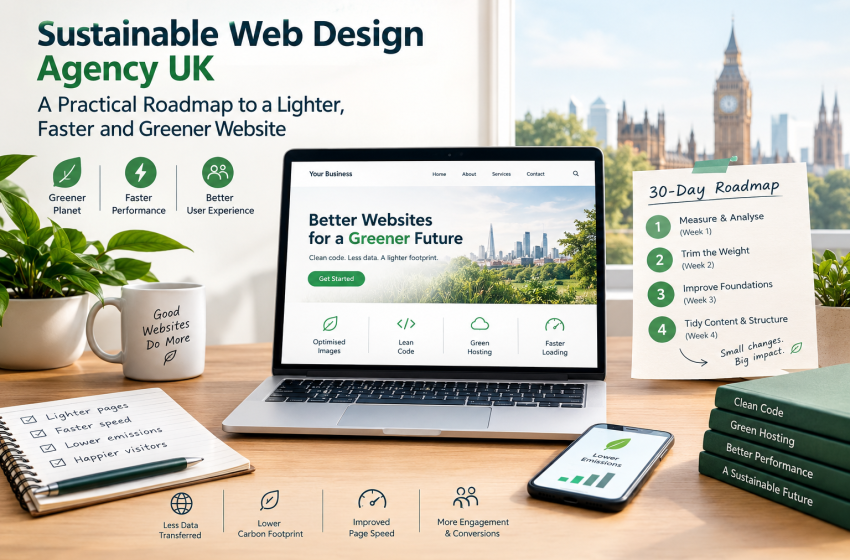
A 30-Day Roadmap Toward a Greener Website
You do not need a full rebuild to start. Work through the weeks in order and you will see real movement.
Week One: Measure Before You Change
Run Your Baseline Tests
Enter your homepage into the Website Carbon Calculator for an estimate of the emissions per visit, then run a performance audit with Google Lighthouse. Screenshot both results so you can compare later.
Find Your Heaviest Pages
List your five most visited pages and note how large each one is. Heavy pages with high traffic are the best place to start, because small improvements are multiplied by every visit.
Week Two: Trim the Weight
Images
Resize pictures to the size they are actually displayed, use modern formats and load images only as visitors scroll to them. This is usually the single biggest saving.
Scripts and Trackers
Audit every chat widget, analytics tag and social embed. If nobody can explain what a script is for, it is a candidate for removal.
Fonts and Video
Limit yourself to one or two typefaces and a handful of weights. Replace background video with a still image, and let visitors choose to press play when video genuinely helps.
Week Three: Improve the Foundations
Check your host with the Green Web Foundation to see whether it is verified as running on renewable energy. If you would like help comparing options, our hosting and domain services team can explain what you are paying for and why.
Then look under the bonnet. On a WordPress site, replace overlapping plugins with lighter alternatives, enable caching and clean up the database. Our WordPress development services include exactly this kind of tidy-up work.
Week Four: Tidy Content and Structure
- Merge or retire thin pages that nobody visits
- Redirect removed pages to the closest useful alternative
- Shorten navigation so visitors reach answers in fewer clicks
- Replace duplicate images and documents with one optimised version
If you discover that the platform itself is the problem, a planned website migration to a cleaner setup can be the most efficient long-term move.
How to Measure Progress Without Drowning in Data
Three Numbers Worth Tracking
- Page weight — how many megabytes your key pages transfer
- Performance scores — loading speed, responsiveness and layout stability
- Estimated carbon per visit — useful as a trend line rather than an exact figure
Add one business measure alongside them, such as enquiries or sales, so you can see whether lighter pages also help your results.
A Simple Reporting Rhythm
Check your key pages monthly and after every significant change. Sites tend to creep back to bloat as new plugins, banners and images pile up, which is why steady website maintenance is the quiet hero of any sustainability plan.
Why Local Web Designers Near Me Can Make Greener Websites Better
Searching “local web designers near me” is not nostalgia; it is a shortcut to people who understand your patch.
Local Knowledge Shapes Leaner Content
When a designer knows your customers, the words people in your area actually use and the competitors nearby, copy can be sharper and pages fewer. Less padding means less to load and less to read.
Local Visibility Without the Bloat
If you serve a specific area, you need clear location details, genuinely useful service pages and a properly maintained Google Business Profile. Our search engine optimization team plans these foundations alongside design. To see how a location-driven site can be organised, take a look at the Restaurants Near Me project.
Collaboration in Person or on Screen
Workshops in London
Our studio is in central London, and we are glad to meet clients in the capital to map out goals on a whiteboard.
Remote Projects Across the UK
Not nearby? No problem. Video calls, shared prototypes and clear milestones keep projects moving for clients across the country.
Where a Greener Website Fits in a Wider Plan
A lighter website is one strand of a bigger picture. If you want to look at the rest of your business operations, the Energy Saving Trust offers practical guidance on reducing energy use. Pair that thinking with an efficient website and your sustainability story becomes consistent rather than superficial.
Choosing a Sustainable Web Design Agency UK Teams Can Rely On
No single firm is the best web development agency UK-wide for every business, so the useful question is which one is right for you. Use these checks.
What They Should Be Able to Show
Ask for before-and-after examples of page weight or performance, and explore their case studies and our projects gallery for the quality of finished work. A project with plenty of live data, such as Cricket Live Score, is a good prompt for asking how an agency keeps fast-changing content efficient.
Language to Treat With Caution
Be wary of sweeping claims such as “carbon neutral website” with no explanation. A trustworthy agency can describe what it measured, how and what it did about it. Honest, specific answers beat impressive slogans every time.
Matching Ambition to Budget
Sustainable improvements scale. You can start with an audit and quick fixes, then move to a deeper rebuild later. Browse our pricing plan to see how packages are organised.
How Web Design Agency UK Approaches Lean Builds
We create responsive, SEO-ready websites for UK businesses, and we are glad to apply the lean-build principles in this guide to your project. Our web development specialists work alongside designers and writers, so speed, structure and content are planned together. Selling online? Our eCommerce development service applies the same thinking to product pages and checkout. You can learn more about us, or read further tips on our blog.
Ready to Lighten Your Website?
Start small this week: test one page, compress its images and remove a script nobody needs. Then take the next step with the roadmap above. Progress beats perfection, and every kilobyte you trim makes your site a little quicker for the people you want to impress.
If you would like a friendly team to help, contact us for a no-obligation conversation about your website. And we would love to hear your result: what did your homepage score in the first test, and what surprised you most?
Frequently Asked Questions
1. What does a sustainable web design agency actually do?
It builds websites that use less data and energy by optimising images, trimming code and scripts, choosing efficient hosting and keeping navigation simple. The aim is a faster, more accessible site that performs well for visitors while reducing unnecessary digital waste.
2. Can a lighter website still look premium?
Absolutely. Strong typography, careful spacing, well-chosen photography and purposeful motion create a polished look without heavy files. Many lean websites feel more premium because they load instantly and let the content do the talking.
3. How do I check whether my hosting is green?
Enter your domain into the Green Web Foundation checker to see whether your host is verified as using renewable energy. If it is not listed, ask your provider about its energy sources or consider moving to a host that publishes clear evidence.
4. Is it worth searching for local web designers near me instead of choosing a larger agency?
It can be, particularly if your customers are nearby and you value in-person workshops and local market knowledge. Many city-based agencies also work nationwide, so judge each on experience, process and communication as well as location.
5. How long does it take to see results from website optimisation?
Speed and page-weight improvements show up as soon as changes go live. Search and conversion benefits usually build over weeks or months, depending on your competition, content and how consistently you measure and maintain the site.