
Try this before you read another word: switch your phone to mobile data, open your own homepage and count the seconds until you can actually read something. If you got to “one-Mississippi, two-Mississippi, three-Mississippi” and the page was still shuffling its images into place, you’ve just felt the problem this article is about. Every one of those seconds is a visitor deciding whether to stay, and every one of them also costs energy somewhere along the chain, from the server to the signal to the screen in your hand.
This guide is for anyone searching for a sustainable web design agency UK businesses can genuinely rely on, or typing “website redesign near me” and getting a wall of identical promises. We’ll look at why websites have a carbon footprint, give you a practical checklist you can use with any agency, explain how a greener build helps your rankings and sales, and show where an online shop and a good WooCommerce web agency fit into the picture. There’s even a simple 30-day plan at the end, so you can start without waiting for a full rebuild.
Why a Website Has a Carbon Footprint (and Why You Should Care)
It’s easy to think of a website as weightless, but it isn’t. Every page view sets off a small chain of events, and each link in that chain uses electricity.
Where the Energy Actually Goes
- Data centres: the servers that store your site and respond to every request
- Networks: the cables, masts and routers that carry your pages to visitors
- Devices: the phones, tablets and laptops that download, process and display everything
The more data your pages ask for, the harder that whole chain works. A page packed with oversized images, autoplaying video and a dozen third-party scripts makes the chain work very hard indeed, for every single visitor.
Putting It in a Business Context
If your company is already looking at its wider environmental impact, your website belongs in that conversation too. The Carbon Trust publishes practical guidance for organisations on understanding and reducing their carbon footprint, and it’s a helpful starting point for placing digital choices alongside travel, energy and supply chains.
A Word of Caution About Big Claims
Be wary of anyone who promises a “zero-carbon website” with no explanation. A sound sustainable approach reduces waste, measures progress and is honest about what it can and can’t change. Small, steady improvements that you can actually prove are worth far more than a slogan.
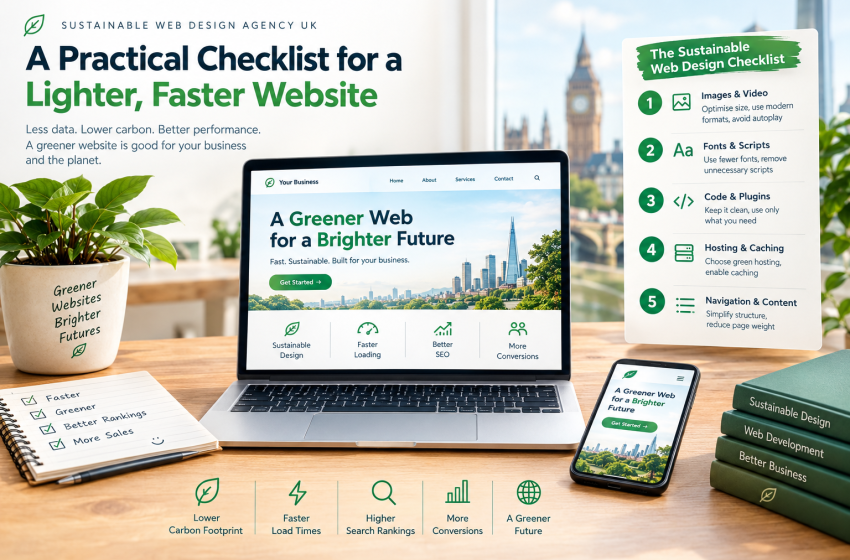
The Sustainable Web Design Checklist
Here’s the checklist we’d walk through with any client. You can use it to audit your current site or to test whether a prospective agency really knows its stuff.
1. Images and Video
Images are usually the heaviest items on a page, so they’re the quickest place to win back speed.
Choose the Right Format and Size
Upload images at the dimensions they’ll actually be displayed, not straight from a camera. Tools such as Squoosh let you compress and convert pictures in your browser and compare the result side by side, so you can see how much quality you really lose (usually very little).
Treat Video With Respect
Autoplaying background video looks impressive in a pitch meeting and punishing on a train with weak signal. Let visitors choose to press play, and use a still image as the placeholder.
2. Fonts and Third-Party Scripts
Each extra font family, weight or tracking script is another file to download. Use fewer fonts, load only the weights you need, and ask a simple question of every script: “What would we lose if this disappeared?” If the honest answer is “nothing much”, remove it.
3. Code and Plugins
Clean code is the engine of a lighter website. Heavy themes and stacks of plugins add weight and slow everything down, which is why a considered web development approach builds only what your site needs. If your site runs on WordPress, our WordPress development services focus on exactly this kind of tidy, purposeful build.
4. Hosting, Caching and Delivery
Good hosting is fast, secure and efficient, and caching stops returning visitors from downloading the same files repeatedly. When you review your hosting and domain services, ask what is included: caching, backups, security and a content delivery network if your audience is spread across regions.
5. Navigation and Content
A visitor who finds the answer in two clicks uses far less data than one who wanders through six pages. Merge thin or duplicate pages, write clear headings, and give each page one obvious next step.
Set a Page Weight Budget
A page weight budget is a simple limit you agree before design begins, such as “no page over a certain size on mobile”. The MDN Web Docs performance guide explains the principles behind performance budgets in plain, practical detail, and it’s a handy reference for developers and non-developers alike.
What a Greener Website Does for Your Rankings and Sales
Here’s the part that makes the business case easy. Almost everything on the checklist above also improves the way people experience your site.
Speed Builds Trust
Pages that load quickly feel professional. Visitors read more, click more and are far more likely to complete an enquiry form or a checkout.
A Solid Base for Search Engine Optimisation
Search engines favour websites that are fast, mobile-friendly and logically structured. A lean build gives you that technical foundation, and professional SEO services can then layer on keyword research, content planning and on-page optimisation. Think of it as pouring good foundations before you worry about the wallpaper.
A Story You Can Be Proud to Tell
More customers and buyers are interested in how the companies they deal with operate. A site that is visibly fast, accessible and thoughtful quietly supports that story, no dramatic claims required.
Website Redesign Near Me: Finding a Greener Partner Without Overpaying
When you search for “website redesign near me”, you’re probably after two things: confidence that someone will answer the phone, and proof that they’ve done this before. Location can help with the first, but only the portfolio can answer the second.
Green Flags to Look For
- They can explain, in plain English, how they’d reduce your page weight
- They show real case studies with live websites you can test on your own phone
- They talk about aftercare, not just launch day
- They’re upfront about pricing and what’s included
Red Flags to Watch Out For
- Environmental claims with no numbers or examples behind them
- Heavy, template-driven designs that load slowly
- No mention of accessibility, hosting or maintenance
- Pressure to sign quickly without a proper discovery conversation
What About Credentials?
If an agency mentions formal certifications, check them. Directories such as B Corp UK let you verify whether a company is certified, which is far more reassuring than a badge pasted into a footer. Credentials aren’t everything, but verifiable ones are a good sign of a team that takes its claims seriously.
Local or Remote: Does It Matter?
We’re based in Covent Garden, London, and we’re happy to meet clients in person. For many projects, though, video calls and shared files work beautifully, and fewer journeys is a small sustainability win in itself. If you’d like to see how we work, take a look at our Web Design Agency UK story.
Greener Online Shops: Where a WooCommerce Web Agency Fits In
Online shops tend to be heavier than brochure websites, with product galleries, filters, reviews and checkout scripts. That makes them one of the best places to apply sustainable thinking, because small savings are repeated across thousands of page views.
What to Ask a WooCommerce Web Agency
- How do you keep product pages fast when there are lots of images?
- Which plugins will you use, and which will you avoid?
- How will you test mobile checkout speed before launch?
- What does ongoing support look like after the store goes live?
Our WooCommerce web development team builds stores with these questions in mind, and our broader ecommerce development work covers other platforms too. If you’d like to see an ecommerce project, have a look at Garden Furniture Sale to get a feel for the kind of product-led site we build.
Your 30-Day Greener Website Plan
You don’t need to wait for a full redesign to make progress. Here’s a gentle plan you can start this week.
Week 1: Measure and Record
Note your current page weight, mobile load time and your five most visited pages. Take screenshots so you can compare later.
Week 2: Fix the Heavy Hitters
Compress your biggest images, remove autoplaying video and delete any plugin or script you don’t need.
Week 3: Tidy Content and Navigation
Merge duplicate pages, update old copy and make sure each page has one clear purpose and one clear call to action.
Week 4: Review Hosting and Plan Ahead
Check what your hosting includes, and decide whether your site needs a bigger redesign. If it does, bring your Week 1 notes to a conversation with your agency, and they’ll have a much clearer brief to work from.
Keep It Healthy
A lighter site stays light only if someone looks after it. Regular website maintenance covers updates, security checks, backups and performance tuning, so your improvements don’t quietly erode over the next year.
Ready for a Lighter, Faster Website?
A sustainable website isn’t a trend. It’s simply a well-made website that respects your visitors’ time, your budget and the wider world. If you’d like an honest conversation about what a greener redesign could look like for your business, we’d love to hear from you.
You can book a free website consultation, check our pricing plan, or call us on 020 8429 5297. We aim to respond within one working day.
One last question to take away: if you had to remove one thing from your homepage tomorrow to make it load faster, what would it be? Tell us in the comments, and we’ll suggest a lighter alternative.
Frequently Asked Questions
1. What does a sustainable web design agency in the UK do?
A sustainable web design agency builds websites that use less data, energy and processing power. That typically includes optimised images, clean code, efficient hosting, focused content and measurable performance targets, all while keeping the design attractive and easy to use.
2. Will a sustainable website look plain or boring?
No. Sustainable design is about making every element earn its place, not removing personality. Well-chosen typography, strong photography, good layout and thoughtful colour can look striking while still keeping pages light and fast.
3. How do I find a good website redesign near me?
Look beyond location. Review the agency’s case studies, ask how they measure performance, check what aftercare is included and make sure pricing is transparent. A UK-based team working remotely can deliver the same quality as one down the road.
4. Can an online shop be sustainable and still sell well?
Yes. Optimised product images, efficient code, sensible plugin choices and a fast checkout reduce energy use and also improve the shopping experience. A skilled WooCommerce web agency can build these principles into your store from day one.
5. How long does a website redesign take?
It depends on the size and requirements of your project. A standard business website can often be completed within a few weeks, while larger ecommerce or custom projects need more time. A discovery call will give you a realistic timeline.