A London bakery owner once told us she’d paid £300 for a website that never once appeared on the first three pages of Google for her own business name. Not her product category — her actual business name. That’s not a rare story. It’s the default outcome when “cheap” gets mistaken for “affordable,” and it’s the exact confusion this post is here to clear up.
There’s a meaningful difference between a website that costs less and a website that delivers more per pound spent. One is a false economy. The other is a genuine business decision. Understanding that difference is the entire point of what follows — along with what to actually expect from custom web design London studios, and how to tell real value from a discount that costs you customers later.
The Real Cost of “Cheap” Web Design
A £300 website and a £3,000 website can look deceptively similar in a screenshot. The differences that actually matter — page speed, mobile behaviour, security, search visibility, and how the site holds up under real customer traffic — don’t show up until weeks or months after launch, usually right around the time a competitor starts outranking you.
Research from usability specialists consistently shows that navigation clarity and page structure directly influence whether visitors stay or leave. Nielsen Norman Group’s research on website navigation has repeatedly found that confusing structure is one of the single biggest drivers of abandoned visits — and confusing structure is exactly what you get from templated builds assembled without a proper information architecture phase.
Then there’s performance. Google’s own Lighthouse auditing tool measures the technical factors — load time, accessibility, best practices — that separate a professionally built site from a rushed one. Cut-price builds routinely fail these audits, which quietly damages both user experience and search rankings from day one.
What Genuinely Affordable Web Design and Development Services Look Like
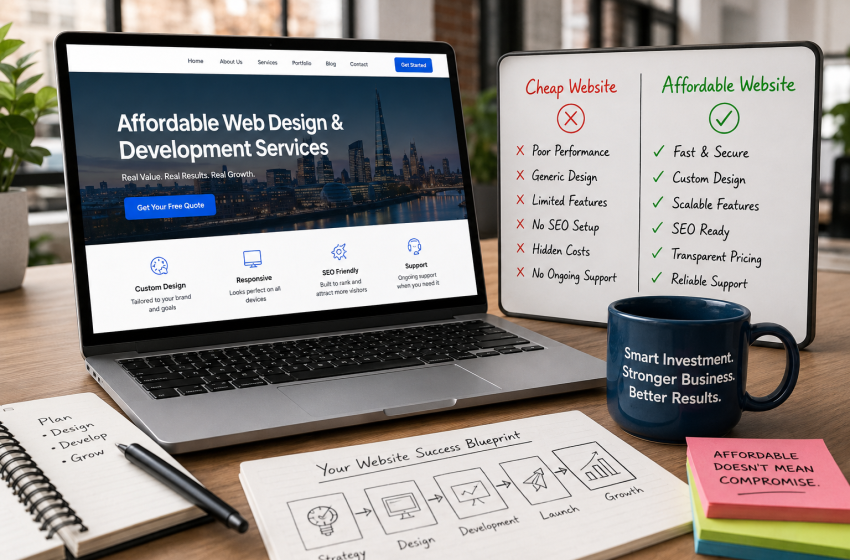
Real affordable web design and development services aren’t defined by a low number on an invoice. They’re defined by a sensible relationship between price and what you actually receive. That typically means:
A build that’s right-sized for your business, not over- or under-built. A five-page local service business doesn’t need the same infrastructure as a national e-commerce operation, and paying for capability you don’t need isn’t “premium,” it’s waste. If you’re selling products online, though, cutting corners on your ecommerce development setup to save money almost always costs more in lost sales than it saves in fees.
Platform choice that matches your team’s actual skills. If your staff will be updating the site themselves, a well-built WordPress site with a sensible content structure is genuinely more affordable long-term than a custom-coded system that requires a developer for every text change.
Transparent scope from the outset. Affordable doesn’t mean vague. A proper quote tells you exactly what’s included — number of pages, responsive design, basic SEO setup, and support period — so there are no surprise invoices three months in.
A realistic view of ongoing costs. Hosting, domain renewal, and security updates are recurring realities, not optional extras. Studios offering bundled hosting and domain services as part of an affordable package tend to save clients the hassle — and the cost — of juggling multiple providers themselves.
Data from the UK’s official statistics body shows just how central digital infrastructure has become to UK commerce — ONS reporting on the IT and internet industry illustrates how much business activity now runs through websites rather than around them. That’s exactly why treating your site as a discretionary expense, rather than core infrastructure, is a mistake regardless of budget size.
Why Custom Web Design London Still Beats Off-the-Shelf Templates
Templates promise speed and low cost, and for a genuinely simple hobby site, that might be enough. But for a business trying to compete in one of the most crowded commercial markets on earth, custom web design London studios offer something templates structurally cannot: design decisions made specifically around your customers, your competitors, and your goals — not a generic best guess built for thousands of unrelated businesses worldwide.
A custom build means your navigation reflects how your specific customers actually shop or enquire, not a one-size-fits-all menu structure. It means your homepage leads with the argument that actually converts your particular audience, rather than a stock layout copied across a thousand other template users. And it means when your business grows — new services, a new product line, a new location — your site can grow with it instead of fighting the limitations of a rigid template.
London businesses in particular face a level of competitive density that makes generic design a genuine liability. When three of your direct competitors are one search result away, “good enough” design isn’t good enough. Reviewing a studio’s our projects page before hiring gives you a realistic sense of whether their previous custom work actually looks distinct from business to business, or whether every project follows the same recycled layout with different logos swapped in.
Questions Worth Asking Before You Commit
Before signing any proposal — affordable or otherwise — it’s worth asking a few pointed questions:
“What happens if I need changes after launch?” Studios offering an accessible support arrangement, rather than treating every future tweak as a new project with a new invoice, are generally easier and cheaper to work with long-term.
“Will my site meet accessibility requirements?” UK organisations are increasingly expected to meet accessibility standards. GOV.UK’s guidance on accessible websites and apps is a useful reference point, and a studio that can’t speak to accessibility confidently is a studio that hasn’t been building to current standards.
“Can you show me results, not just designs?” Ask about outcomes — increased enquiries, improved rankings, higher conversion rates — from real client projects, not just visual portfolios.
“What happens if I outgrow this site?” A good studio will have a clear answer about scalability, whether that’s adding e-commerce functionality later, migrating platforms, or expanding into new site sections. If you’re planning a platform change down the line, ask specifically about their website migration process so you know what that transition will actually involve.
“Who are you, really?” It’s worth spending five minutes on a studio’s about us page before you commit — team experience, years operating, and genuine specialisms tell you more than a slick homepage ever will.
The Bottom Line on Affordable, Custom Web Design
Affordable and cheap sound similar but produce entirely different outcomes. Cheap optimises for the smallest number on an invoice today. Affordable optimises for the best return over the life of the website — better performance, better rankings, fewer surprise costs, and a site that actually represents your business the way it deserves to be represented.
If you’re weighing up quotes right now and want an honest read on whether a proposal represents genuine value or a false economy, we’re happy to look it over with you — no obligation, no pressure. Contact our team and tell us what you’re comparing; we’ll give you a straight answer.
If your current site were graded purely on how well it actually serves your customers today, what grade would it get — and is that a grade you’re comfortable competing on?
5 Frequently Asked Questions
- Are affordable web design and development services actually good quality? They can be, provided the scope is transparent and right-sized for your business. The issue isn’t low cost itself — it’s low cost combined with hidden gaps in SEO, mobile optimisation, or support, which usually cost more to fix later than they saved upfront.
- What’s the difference between a cheap website and an affordable one? A cheap website is priced low regardless of what’s included or excluded. An affordable website is priced sensibly for genuine value — the right features, properly built, with clear ongoing support — for your specific business needs.
- Why is custom web design London better than a template? Custom design is built around your specific customers, competitors, and goals, while templates offer a generic layout shared by thousands of unrelated businesses. In a competitive market like London, that distinction directly affects conversions.
- How much should affordable web design cost in the UK? Costs vary significantly based on scope, platform, and features like e-commerce functionality. Rather than comparing a single number, compare what’s included — pages, SEO setup, responsive design, and post-launch support — across quotes.
- Do affordable websites still rank well on Google? Yes, provided the build follows sound technical and SEO practices from the start. Price doesn’t determine rankings directly — structure, speed, mobile-friendliness, and content quality do, all of which should be part of any properly scoped project.