Choosing a web design agency means choosing the team that will shape how customers discover, judge and contact your business online. The best partner does far more than make pages look attractive: it connects strategy, user experience, development, search visibility, performance and conversion tracking. For a UK business, the right choice is an agency that can prove relevant experience, explain its process clearly, build for mobile users and search engines, and support the site after launch.
Quick Answer / TL;DR
A web design agency should combine business discovery, UX planning, responsive design, development, SEO foundations, testing and post-launch support. Shortlist agencies by reviewing real projects, asking how they measure results, checking who will actually do the work and confirming ownership of your website, domain and data. Choose the team that explains trade-offs clearly and links design decisions to enquiries, sales or another measurable business goal.
Table of Contents
- What a web design agency does
- Why choosing the right agency matters in the UK
- Services to expect
- How to compare agencies step by step
- Agency, freelancer or DIY comparison
- Questions to ask before signing
- FAQs
- Key takeaways
What Does a Web Design Agency Actually Do?
A web design agency is a professional team that plans, designs, develops, launches and often maintains websites. A capable agency combines several disciplines: business strategy, information architecture, user experience (UX), user interface (UI) design, front-end development, content management systems, technical SEO, analytics and quality assurance.
That breadth matters because a website is not a poster. It is an active business system. A visitor may arrive from Google, an AI answer engine, social media, an advert or a referral; scan the page on a phone; compare several providers; and decide within minutes whether to enquire. Design, content and technology have to work together.
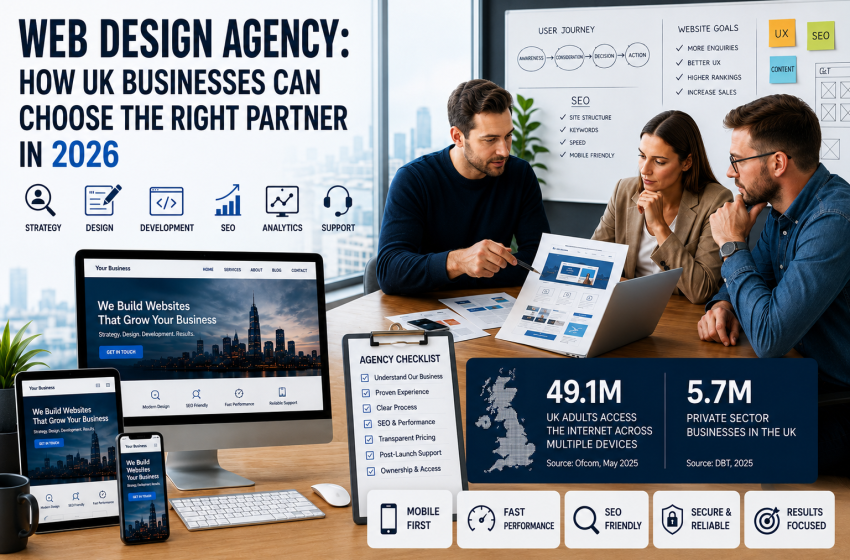
The UK market is large and competitive. The Department for Business and Trade estimated 5.7 million private-sector businesses at the start of 2025, including 5.64 million small businesses. Ofcom also reported that 49.1 million UK adults accessed the internet through smartphones, tablets and computers in May 2025. Those figures show why a professional website must be easy to find, quick to understand and simple to use on multiple devices.
What is the difference between design and development?
Web design covers the structure, look, interaction patterns and user journey. Web development turns those decisions into a functioning website using a CMS or custom code. Strong agencies treat the two as one connected process rather than handing over a visual concept that is difficult to build, slow to load or hard to manage.
What platforms should an agency understand?
The right platform depends on the project. WordPress remains a major part of the web: W3Techs reported in July 2026 that WordPress powered 41.5% of all websites and held 59.2% of the known CMS market. Shopify, Webflow and custom solutions can also be the right choice when the business model, ecommerce requirements or integration needs justify them.
A trustworthy agency should recommend a platform after understanding your goals, not before. Ask why a specific CMS is being proposed, what it costs to maintain, how easy it is to update and whether you can move away from it later.
Why Does Choosing the Right Web Design Agency Matter?
A poor website project usually fails for one of three reasons: the team starts designing before understanding the business, the build is judged only by appearance, or the launch is treated as the finish line. The right web design agency avoids those mistakes by defining goals, users, content and measurement before production begins.
For example, a brochure website may need qualified enquiries. An ecommerce website may need product discovery, checkout completion and repeat purchases. A recruitment site may need search visibility, job filtering and applications. The best design decisions are different for each case.
Performance is also part of modern design quality. Google’s web.dev guidance defines good Core Web Vitals as Largest Contentful Paint within 2.5 seconds, Interaction to Next Paint at 200 milliseconds or less, and Cumulative Layout Shift at 0.1 or less. These are technical metrics, but they describe experiences that users can feel: fast loading, responsive interactions and stable pages.
Why should SEO be considered before design starts?
SEO should influence navigation, page types, URL structure, internal linking and content requirements. Adding keywords after the site is built is not enough. A professional web design process maps important search topics to useful pages and makes sure search engines can crawl and understand them.
This is especially important for an established site. Redesigning without mapping existing URLs, rankings and backlinks can create avoidable losses. If the project includes URL or platform changes, migration planning should begin before development.
What Services Should a Professional Web Design Agency Include?
A good proposal should make the scope easy to understand. The exact deliverables vary, but most serious projects include the following areas.
Discovery and business strategy
The agency should learn what the company sells, who buys it, why customers choose it, which competitors matter and what a successful website should achieve. Useful outputs may include a discovery brief, goal hierarchy, audience segments and an initial measurement plan.
Information architecture and content planning
Information architecture is the organisation of pages and navigation so users and search engines can understand the site. It usually includes a sitemap, page hierarchy and decisions about where key services, sectors, locations, resources and proof points belong.
UX and UI design
UX focuses on how people complete tasks. UI focuses on the visual interface. The process may include wireframes, prototypes and final design systems covering typography, colours, buttons, forms, cards and responsive behaviour.
Development and CMS configuration
Development should produce clean templates, reusable components and a manageable CMS. Ask what is custom, what relies on plugins or third-party tools, and how updates are handled.
SEO, analytics and launch support
At minimum, the project should cover editable titles and descriptions, indexation controls, XML sitemaps, canonical rules, redirects where needed, analytics and Search Console setup. Launch support should include a checklist and a period for fixing issues found after real users arrive.
How Do You Compare a Web Design Agency Step by Step?
Use a structured process rather than choosing the most attractive homepage or the lowest quote.
1. Write down the business outcome
Start with a simple statement: “The new website should help us generate more qualified enquiries from UK businesses,” or “The new store should make mobile purchasing easier.” This gives every agency the same problem to solve.
2. Define must-have requirements
List essential pages, languages, integrations, ecommerce functions, booking systems, CRM connections, accessibility needs and content responsibilities. Separate must-haves from nice-to-haves so quotes are comparable.
3. Review relevant work, not just famous logos
Ask for projects with similar complexity or customer journeys. A portfolio is more useful when the agency explains the brief, constraints, decisions and result. Visual taste alone does not prove strategic or technical ability.
4. Ask who will work on the project
Find out whether strategy, design, development and SEO are handled in-house, by named specialists or by subcontractors. Outsourcing is not automatically a problem, but responsibility and communication should be clear.
6. Compare scope, assumptions and exclusions
Two quotes can look similar while including very different work. Compare content writing, image sourcing, migration, SEO, accessibility, testing, training, hosting, licences and support. Ask what would trigger extra costs.
7. Check measurement and ownership
Confirm who owns the domain, hosting account, source files, analytics properties and CMS access. You should also know how success will be measured after launch.
How Do Agency, Freelancer and DIY Options Compare?
| Option | Best for | Main strengths | Main risks |
| Full-service agency | Businesses needing strategy, design, development and ongoing support | Broader expertise, project management, continuity | Higher investment and more formal process |
| Specialist freelancer | Smaller or clearly defined projects | Direct communication, lower overhead, specialist depth | Capacity limits and dependency on one person |
| DIY website builder | Very early-stage or simple information sites | Low upfront cost and fast setup | Time burden, generic structure, limited strategic support |
The right choice depends on risk and complexity. A simple one-page test site does not need the same team as an ecommerce rebuild, multi-language platform or SEO-sensitive redesign. A web design agency is most valuable when several disciplines must be coordinated and the website has a meaningful commercial role.
What Questions Should You Ask Before Hiring a Web Design Agency?
Ask direct questions and look for clear, non-defensive answers:
- How will you learn about our customers and business model?
- Which parts of the project are included, excluded or optional?
- Who will be our day-to-day contact?
- How do you plan mobile layouts and accessibility?
- What SEO work is included before launch?
- How do you protect existing rankings during a redesign?
- What tools or plugins create ongoing costs?
- How are revisions handled?
- What testing is completed before launch?
- What support is available after launch?
Frequently Asked Questions
What is a web design agency?
A web design agency is the misspelled search form of “web design agency.” It refers to a company that plans, designs, develops and often maintains websites for organisations. A full-service agency may also provide SEO, ecommerce, analytics, hosting and migration support.
How much does a web design agency cost in the UK?
Cost depends on scope, complexity, content, integrations and support. A simple brochure site and a custom ecommerce platform are different products, so compare detailed deliverables rather than headline prices. Ask for assumptions, exclusions and ongoing costs in writing.
How long does a professional website take to build?
A small site may take several weeks, while a bespoke or ecommerce project can take several months. Timelines depend heavily on decision-making, content readiness, integrations and feedback speed. A good agency provides milestones and identifies client responsibilities early.
Should SEO be included in a web design project?
Yes, at least at a foundational level. Site structure, page templates, speed, metadata, internal links, crawlability and redirects affect search performance. Ongoing SEO can be separate, but the website should not launch with preventable technical problems.
Is WordPress still a good choice in 2026?
WordPress remains widely used and can be a strong option when flexibility, content publishing and a broad ecosystem are important. W3Techs reported that it powered 41.5% of all websites in July 2026. The right choice still depends on governance, security, ecommerce needs and maintenance capacity.
Key Takeaways
- A web design agency should connect design decisions to measurable business goals.
- Compare discovery, UX, development, SEO, testing and support—not just portfolios.
- Mobile performance matters because millions of UK adults access the internet across connected devices.
- Use clear requirements and the same brief when comparing proposals.
- Confirm ownership of domains, analytics, content and website access before signing.
- Treat launch as the start of measurement and improvement, not the end of the project.
Call to Action
Planning a new website or redesign? Web Design Agency UK offers web design, development, SEO, WordPress, Shopify, ecommerce, maintenance and website migration services for UK businesses. Review the team’s work and discuss your goals before deciding on the right scope.