
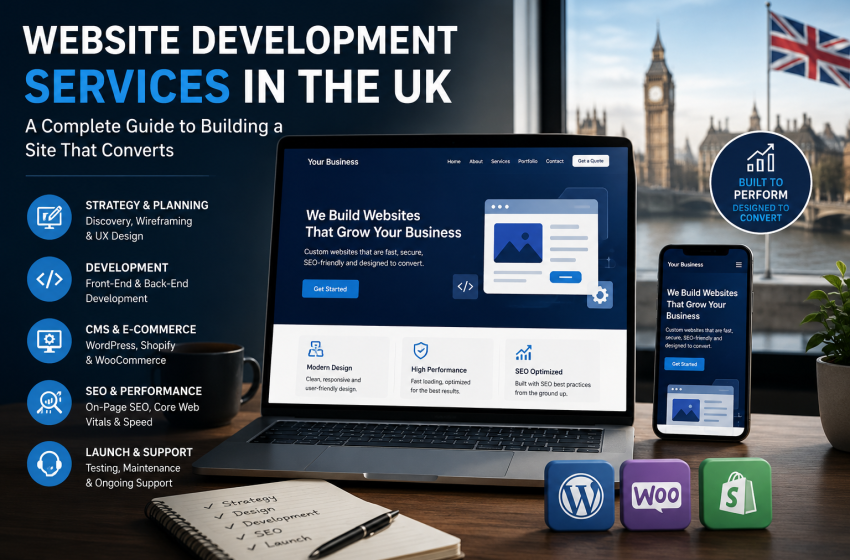
Ask ten UK business owners what “website development” actually involves, and you’ll likely get ten different answers — some think it’s just design, others assume it’s purely coding, and a few aren’t sure where SEO fits in at all. That confusion is exactly why so many projects go over budget, miss deadlines, or launch without the features a business actually needed. This guide breaks the process down properly, from the technology decisions made in week one to what should happen after the site goes live, so you know exactly what to expect and what to ask for.
What Website Development Services in the UK Actually Include
“Development” is often used as a catch-all term, but a proper build is made up of several distinct disciplines working together.
Front-End vs Back-End Development
Front-end development is everything a visitor sees and interacts with — layout, navigation, buttons, forms. Back-end development is the engine behind it: databases, server logic, content management, and how the site handles things like form submissions or product inventory. A site that looks polished but has weak back-end architecture will struggle the moment it needs to scale or integrate with other tools.
CMS-Based vs Custom-Coded Builds
Most UK businesses don’t need a fully custom-coded platform from scratch — a well-configured content management system covers the vast majority of use cases while keeping ongoing edits manageable for non-technical staff. Custom coding tends to make more sense for businesses with unusual functionality requirements: booking engines with complex logic, membership portals, or bespoke internal tools.
Planning a Custom Website Development Project in the UK
The quality of the finished site is decided long before any code is written.
Discovery and Strategy
This stage should cover your business goals, target audience, competitor landscape, and the specific actions you want visitors to take — whether that’s calling, booking, or buying. Skipping this step is the single biggest reason websites end up looking good but generating few actual enquiries.
Wireframing and UX Design
Wireframes map out structure and user flow before visual design begins, making it far cheaper to fix navigation or layout problems here than after development starts.
Content and Copywriting
Even the best-designed layout falls flat without clear, persuasive copy. Content planning — headlines, calls to action, service descriptions — should happen alongside design, not as a rushed afterthought once the build is nearly finished.
Choosing the Right Technology Stack
The platform you build on affects cost, flexibility, and how easily you can maintain the site yourself later.
WordPress
WordPress remains one of the most widely used content management systems globally, largely because of its flexibility and the size of its plugin ecosystem. A properly configured WordPress development build gives non-technical teams an easy way to manage content without needing a developer for every small change.
Shopify & WooCommerce for E-commerce
For online stores, the choice usually comes down to a hosted platform like Shopify versus a WordPress-based store built on WooCommerce. Each has trade-offs around monthly costs, design flexibility, and how much control you have over the checkout experience — worth reviewing directly on WooCommerce’s own platform overview and Shopify’s official comparison resources before deciding.
Which Platform Fits Your Business
As a rough guide: businesses wanting maximum design flexibility and content control often lean toward WordPress with WooCommerce, while those wanting a faster, more managed setup with less technical overhead often prefer Shopify. Neither is universally “better” — it depends on your product range, growth plans, and how hands-on you want to be with the backend.
SEO and Performance Considerations During Development
SEO built in from day one is far more effective — and cheaper — than SEO bolted on after launch.
Core Web Vitals
Page speed and loading stability directly affect both user experience and search rankings. Development teams should be testing against Google’s Core Web Vitals benchmarks throughout the build, not just checking speed once at the very end.
On-Page SEO Foundations
This includes clean URL structures, properly nested heading tags, descriptive meta titles and descriptions, image alt text, and internal linking between related pages. A dedicated search engine optimization setup at launch gives a new site a genuine head start over one that treats SEO as a future project.
Website Design UK: Balancing Aesthetics and Function
Good websites design work isn’t just about looking current — it’s about guiding visitors toward a decision without friction. That means legible typography, clear visual hierarchy, obvious calls to action, and layouts that hold up just as well on a phone screen as they do on a desktop monitor. A site that photographs well in a portfolio but confuses real visitors isn’t doing its job, regardless of how polished it looks.
What to Expect From the Development Process
Timeline
A standard brochure-style business website typically moves from kickoff to launch within a few weeks. Larger builds — multi-language sites, custom booking systems, or full e-commerce stores — reasonably take longer, particularly where third-party integrations are involved.
Testing & Launch
Before going live, a proper build should be tested across major browsers and devices, checked for broken links and form functionality, and reviewed for basic accessibility. Rushing this stage is a common cause of post-launch firefighting.
Post-Launch Support
Launch isn’t the finish line. Security updates, backups, uptime monitoring, and small content edits are ongoing needs — which is why it’s worth confirming what website maintenance looks like before the project even starts, rather than negotiating it under pressure after something breaks.
Choosing Between Freelancers and Established UK Web Design Agencies
Freelancers can be a sensible choice for very small, simple sites with a tight budget. But for anything involving e-commerce, custom integrations, or ongoing SEO, a full agency team — covering design, development, content, and support — tends to reduce risk considerably, since the project isn’t dependent on a single person’s availability. You can see the range of builds handled end-to-end by browsingc completed projects from past client engagements.
Final Thoughts
Custom website development in the UK isn’t a single task — it’s a sequence of decisions, from platform choice through to SEO structure and post-launch support, each of which affects how well the finished site actually performs. The businesses that get the best results tend to be the ones that ask detailed questions upfront, rather than assuming every agency or platform will deliver the same outcome.
If you’re mapping out a new build or planning to rebuild an existing site, it’s worth getting a tailored quote that lays out platform, timeline, and SEO scope clearly before any work begins — that clarity upfront is usually what separates a smooth project from a stressful one.
Frequently Asked Questions
- What’s included in typical website development services in the UK? Most full-service builds include discovery and strategy, UX wireframing, visual design, front-end and back-end development, CMS setup, basic on-page SEO, cross-device testing, and a defined handover process for ongoing maintenance.
- How much does custom website development cost in the UK? Costs vary significantly depending on complexity — a simple brochure site costs far less than a custom-built e-commerce platform with integrations. A detailed quote should break down design, development, and any recurring hosting or maintenance costs separately.
- Should I choose WordPress or a custom-coded website? WordPress suits most standard business and e-commerce needs and is easier to manage without ongoing developer support. Custom coding tends to make sense only when a business needs highly specific functionality that off-the-shelf plugins can’t reasonably handle.
- How important is page speed for a new website? Very important — slow-loading pages increase bounce rates and can negatively affect search rankings. Performance should be tested throughout development, not just once before launch.
- Do website development services include ongoing SEO? Not always by default. Development typically covers on-page SEO foundations at launch, while ongoing SEO — content, link building, technical monitoring — is usually a separate, continuing service worth discussing during the initial planning stage.